What Is Chimney Flashing?
A brown stain spreads across the ceiling next to the chimney. It appears after heavy rain, dries out, then comes back a little bigger with the next storm. The roof looks fine. The chimney looks fine. So where is the water coming from? More often than not, the answer is the flashing — the metal seal where the chimney passes through the roof. It is the least visible part of the chimney, and the most common source of leaks that look like roof leaks.
The Short Answer
Chimney flashing is the metal seal where a masonry chimney passes through the roof. It covers the joint between the brick and the roofing, and its job is to send rainwater down the roof and away from the chimney instead of letting it run into the gap. It is not one piece of metal. It is an assembly of several shaped pieces, layered so water always flows over the next piece down — never under it. When it is installed right, you never think about it. When it fails, water gets into the roof structure, the attic, and the ceiling below, often far from the chimney itself.
The Four Parts
Good chimney flashing is an assembly, not a single sheet of metal. It has four parts, and each one covers a different side of the chimney.
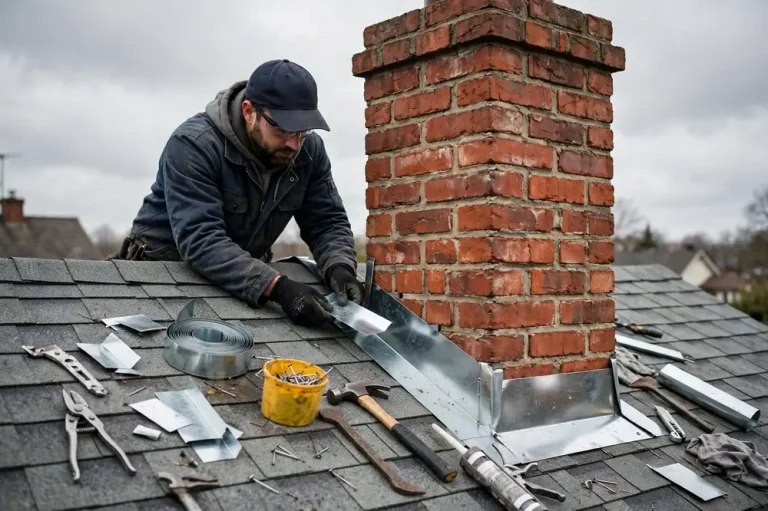
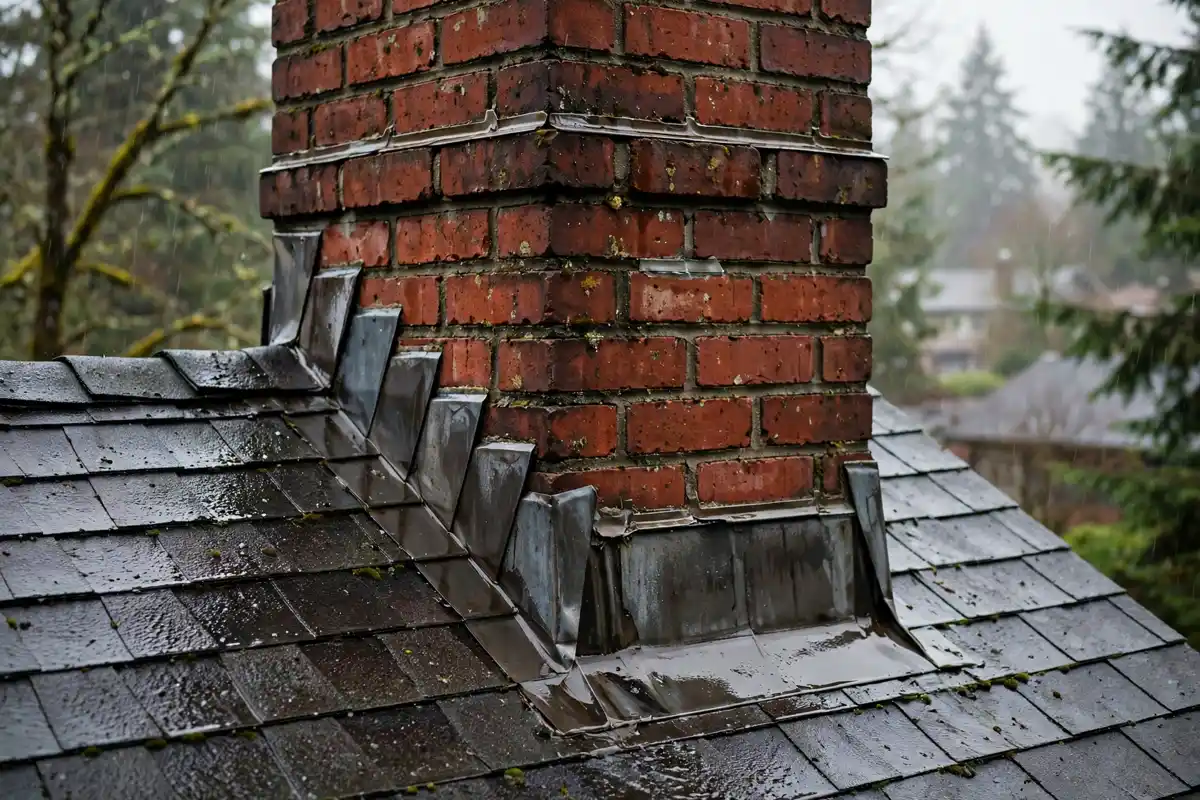
Apron flashing covers the front — the downhill side, where the roof meets the chimney face. It is a single wide piece of metal that runs up the chimney a few inches and down the roof slope, so water flows over it and past the chimney.
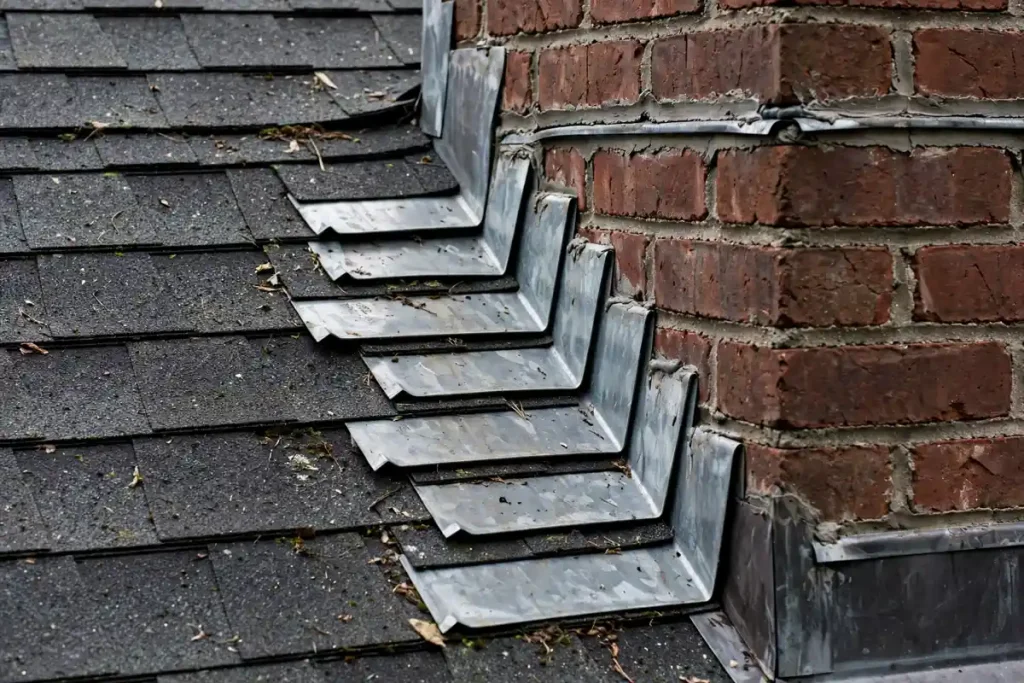
Step flashing covers the two sides. It is made of small L-shaped pieces, woven into the shingles one course at a time: a piece of flashing, a shingle over it, another piece of flashing, another shingle. Each piece overlaps the one below, so water always runs over the next piece down.
Counterflashing covers the top edges of the step flashing. It is set into the mortar joints of the brick and hangs down over the step flashing below, so water running down the brick face cannot get behind it.
The cricket, also called a saddle, sits on the uphill side, behind the chimney. On a wide chimney it is a small peaked structure that splits the water running down the roof and sends it around the sides. Without a cricket, water pools against the back of a wide chimney, and pooled water finds every gap. A cricket is needed on chimneys wider than about 30 inches; on a narrow chimney, a simple back flashing piece does the same job.
Flashing vs. Cap vs. Crown
Three parts of the chimney all deal with water, and people mix them up. The distinction is simple once you see where each one sits.
The crown is the concrete slab across the top of the masonry. It protects the brick from water coming in from above — read our guide on what a chimney crown is for the full picture.
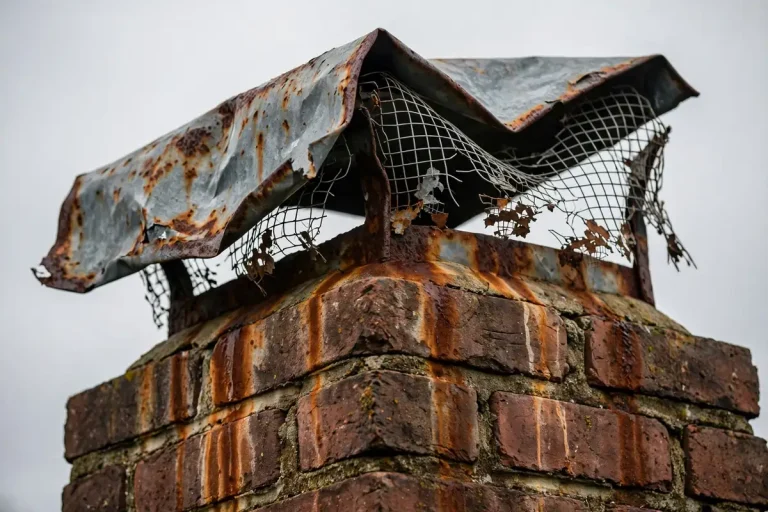
The cap is the metal cover over the flue opening. It keeps rain, animals, and debris out of the flue itself. Our guide on why every chimney needs a cap covers it in full.
The flashing is the seal at the bottom, where the chimney meets the roof. It does not protect the top of the chimney. It protects the joint. The crown covers the top, the cap covers the hole, and the flashing seals the base. A leak at the ceiling beside the chimney is almost always the flashing, not the crown or the cap — water from the top of the chimney shows up in the firebox, while water from the flashing shows up in the ceiling and the attic.
How Flashing Fails
Rust and corrosion come first. Galvanized steel flashing eventually rusts through, especially in a climate as wet as Portland’s. Copper and stainless steel last far longer, but they cost more, so older chimneys usually have galvanized flashing that is now near the end of its life.
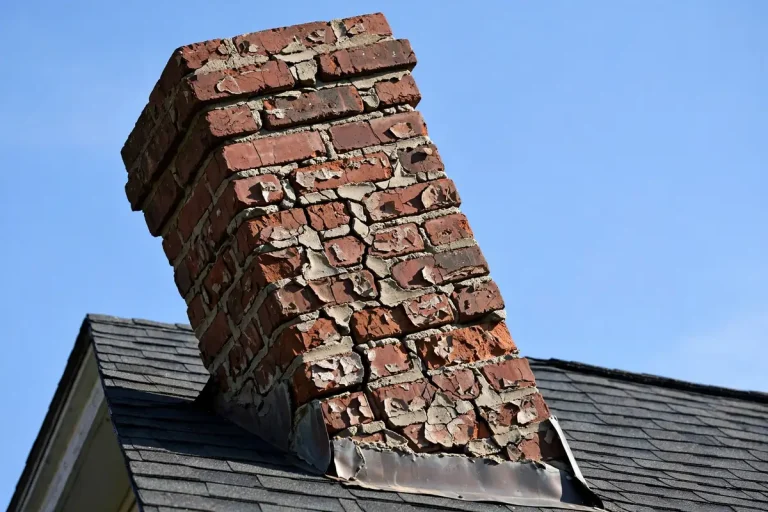
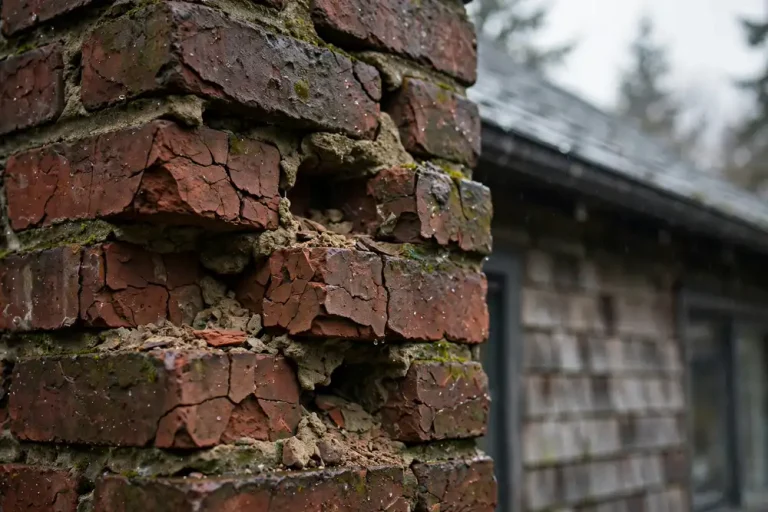
Second, flashing pulls away from the brick. The house settles, the chimney moves slightly with freeze and thaw, and the counterflashing works its way out of the mortar joint. Once a gap opens, water runs straight behind it.
Third, the mortar joints holding the counterflashing crack. Counterflashing is only as solid as the joint it is set into. If the joints are crumbling, the flashing has nothing to grip — and the fix starts with tuckpointing, not with new metal.
Fourth, a wide chimney has no cricket. Water pools against the uphill side, sits there through every storm, and works its way under the back flashing piece by piece.
Fifth, a new roof does not automatically mean new flashing. Roofers often reuse old flashing to save time, or fit new shingles around old metal. Old flashing on a new roof is one of the most common causes of a leak that starts right after a re-roof.
And sixth, the pinhole problem. At the corners, where pieces are folded and nailed, tiny holes can open up and let water through a few drops at a time. Some roofers now use winged flashing, shaped to cover the corners without a nail hole at the fold, precisely to avoid this. A pinhole leak is slow and hard to find, which is why it often shows up as a stain that grows over months, not a drip you can trace in a day.
How to Tell If Your Flashing Is Leaking
A flashing leak and a roof leak look alike from inside the house, but there are clues. The stain is next to the chimney — water from flashing runs down the chimney breast or the roof deck beside it, so the stain sits close to the chimney, on the ceiling beside it or the wall below the attic. It appears after rain, not all the time — a stain that darkens after storms and dries between them points to the outside, not to plumbing. The attic tells the truth — on a rainy day, look at the underside of the roof deck around the chimney. Damp wood, dark staining, or drips right beside the chimney mean the flashing; dampness spread across the roof, away from the chimney, points to the roof itself. And the chimney is the suspect when the roof is new — if the leak started after a re-roof, the flashing was probably reused or fitted badly.
If you are seeing stains and cannot tell where the water comes from, our guide on why chimneys leak walks through the five entry points in order, from the top down. Flashing is one of the five, and checking the others first rules them out.
Repair or Replace?
Whether flashing is repaired or replaced depends on what is wrong with it. A repair is usually enough when the metal is sound and the problem is small: a gap where the counterflashing pulled out of the joint, a lifted piece of step flashing, or a failed seal at one corner. Replacement is the better call when the metal is rusted through, the flashing was installed wrong from the start — step flashing that was never woven into the shingles, or a wide chimney with no cricket — or when the roof is being replaced anyway. Putting new shingles around old flashing saves a little money now and usually costs a leak later. One warning: a bead of sealant over a failed joint is a patch, not a repair. Sealant dries, cracks, and peels, and it cannot hold back water that is pooling behind the chimney.
Why Portland Rain Is Hard on Flashing
Portland gets roughly 40 inches of rain a year, spread across about 150 rainy days, mostly between October and April. Flashing here spends months at a time wet, with barely a dry stretch to recover. That steady wetting is what kills galvanized flashing first — it never fully dries, so rust never stops. It is also what makes a small gap matter. In a dry climate, a gap behind the counterflashing might let in a little water a few times a year. Here, it lets in water for months, and the wood around it stays damp long enough to stain, soften, and rot. Many of the city’s brick chimneys are decades old, and their flashing is original — galvanized steel, fitted when the house was built, now rusting through at the folds.
The Bottom Line
Chimney flashing is one of those parts you never think about until it fails — and when it fails, it looks like a roof leak, which is why it gets misdiagnosed so often. It is four pieces of metal, layered so water always runs over the next piece down: apron in front, step flashing at the sides, counterflashing over the top edges, and a cricket behind a wide chimney.
If you have a stain on the ceiling beside the chimney, or damp wood in the attic around it, call Portland Chimney Care at +1 (503) 433-7104. We serve Portland, OR, and we can tell you plainly whether it is the flashing, the roof, or something else — and whether it needs a repair, a replacement, or nothing at all.