
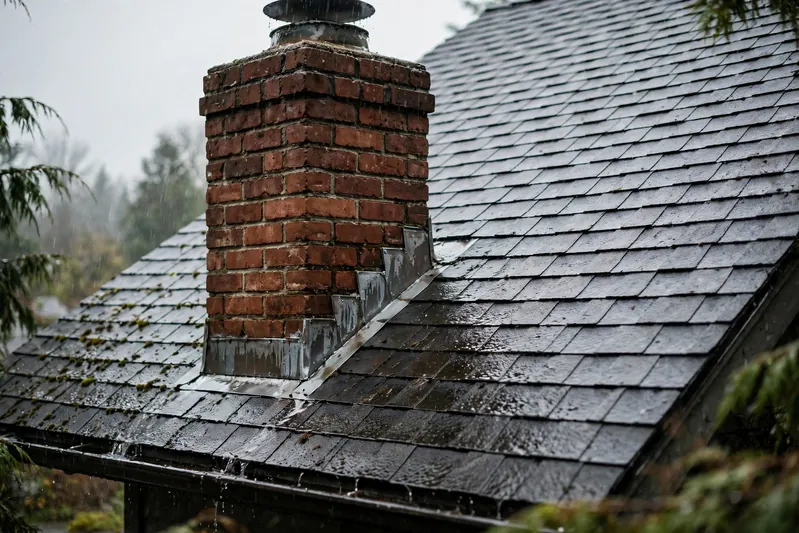
Signs Your Chimney Flashing Is Leaking
Short answer — A flashing leak rarely announces itself with a drip. It shows up as a stain on the ceiling beside the chimney, paint peeling on the wall below the attic, or damp insulation you only find when you go up to look — and by then the water has been getting in for a while.
The signs your chimney flashing is leaking are easy to miss at first, because the stain almost never appears where the water gets in. Water travels along rafters and decking before it shows, so the mark on your ceiling can sit feet away from the failed seam.
The Signs Inside the House
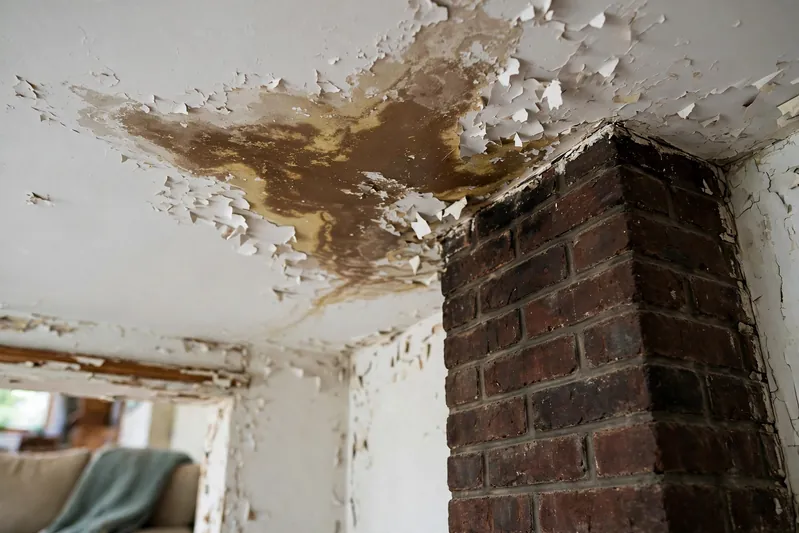
The most common indoor sign is a stain on the ceiling close to the chimney, or on the wall the chimney passes through. It darkens after rain and fades slowly in dry weather — and it comes back with the next storm, because the entry point was never touched.
Peeling paint and bubbling drywall around the chimney breast point the same way, and so does damp or compressed insulation in the attic beside the chimney. A musty smell in the rooms around the chimney, or on the attic wood, is worth checking too: it means moisture has been sitting there long enough to grow mould.
Water in the firebox after rain is a different clue — it usually points to the top of the chimney, not the flashing — but dampness on the attic wood around the chimney, or daylight where the flashing should meet the brick, is a flashing sign.
The Signs Outside the House
Rust streaks down the brick are one of the clearest signs your chimney flashing is leaking. Galvanized steel flashing rusts through at the folds first, and the orange stain on the brick below is the metal telling you it has failed.
Look for flashing that has pulled away from the brick, lifted at a corner, or gone wavy along the roofline. Cracked mortar where the counterflashing is set into the joints is another sign: the flashing is only as solid as the joint holding it, and crumbling mortar leaves it with nothing to grip.
Debris dammed behind the chimney is a Portland speciality: moss and leaves pile up on the uphill side, hold water against the brick, and force it under the back flashing piece by piece. And a thick smear of caulk or tar over the flashing is a red flag, not a repair — it means someone patched the leak instead of fixing it.
Is It Really the Flashing?
Flashing is not the only leak source, and treating it as the only one is the most common mistake. Five parts can let water in, and the stain alone cannot tell you which one failed — so work through them in order, from the top down.
Crown: the sloped concrete slab at the top of the stack. When it cracks, water gets a direct path into the brick, the mortar, and the flue — our guide to what a chimney crown is explains how to spot the damage from the ground.
Cap: a missing or rusted cap lets rain fall straight down the flue, so water in the firebox points to the top, not the flashing. Our guide to why every chimney needs a cap covers the signs a cap has failed — and if the cap is missing entirely, our guide on whether a missing cap causes leaks walks through where the water shows up.
Mortar: crumbling joints let water soak through the masonry itself, and the fix starts with tuckpointing, not new metal. A chimney with sound flashing and bad mortar will still leak.
Flashing: the metal seal where the chimney meets the roof. If the stain sits close to the chimney and darkens after rain, the flashing is the prime suspect — our guide to what chimney flashing is explains the four parts and how each one fails.
Roof: a stain that spreads across the open deck, or appears far from any chimney, is a roof problem, not a chimney one. Our guide to roof leak or chimney leak walks through the tests that tell them apart.
When two or more of these look possible, the tracing method matters more than the guess. Our guide on how to find the source of a chimney leak works from the stain backwards and tests one component at a time — flashing first, then masonry, crown, and cap — until the entry point shows itself.
Why Portland Rain Makes Flashing Fail Faster
Portland gets roughly 40 inches of rain a year, spread across about 150 rainy days, mostly between October and April. Flashing here spends months at a time wet, with barely a dry stretch to recover — and that steady wetting is what kills galvanized steel first, because it never fully dries, so rust never stops.
The rain here is also long and soaking rather than short and hard. A flashing edge that sheds a quick downpour can still let in water during a six-hour soaking rain, especially when the wind drives it sideways — and a leak that only appears in wind-driven rain is a strong flashing signal.
Freeze-thaw adds the last push. Water sits in a hairline mortar crack, freezes overnight, and the crack grows a little at a time — and each winter the counterflashing loses a little more of its grip on the joint.
What You Can Check from the Ground
If the signs your chimney flashing is leaking keep pointing at the metal seam, the next step is an inspection, not a tube of sealant. Sealant over a failed seam hides the leak for a season and leaves the water still getting in behind it.
From the ground, binoculars are enough: look for rust streaks, lifted corners, wavy metal along the roofline, and debris piled behind the chimney. Check the attic on a rainy day, too — damp wood or dark staining on the framing beside the chimney confirms the leak is coming from the chimney, not the roof.
Do not climb onto a wet roof to check the flashing or the crown yourself. The close-up check — photos of the crown, the cap, the flashing, and the masonry — is a roof-level job, and it is done with the right equipment and someone watching from below. A chimney inspection photographs every water-shedding component and tests them one at a time until the entry point shows itself.