Water Damage Around Fireplaces Explained
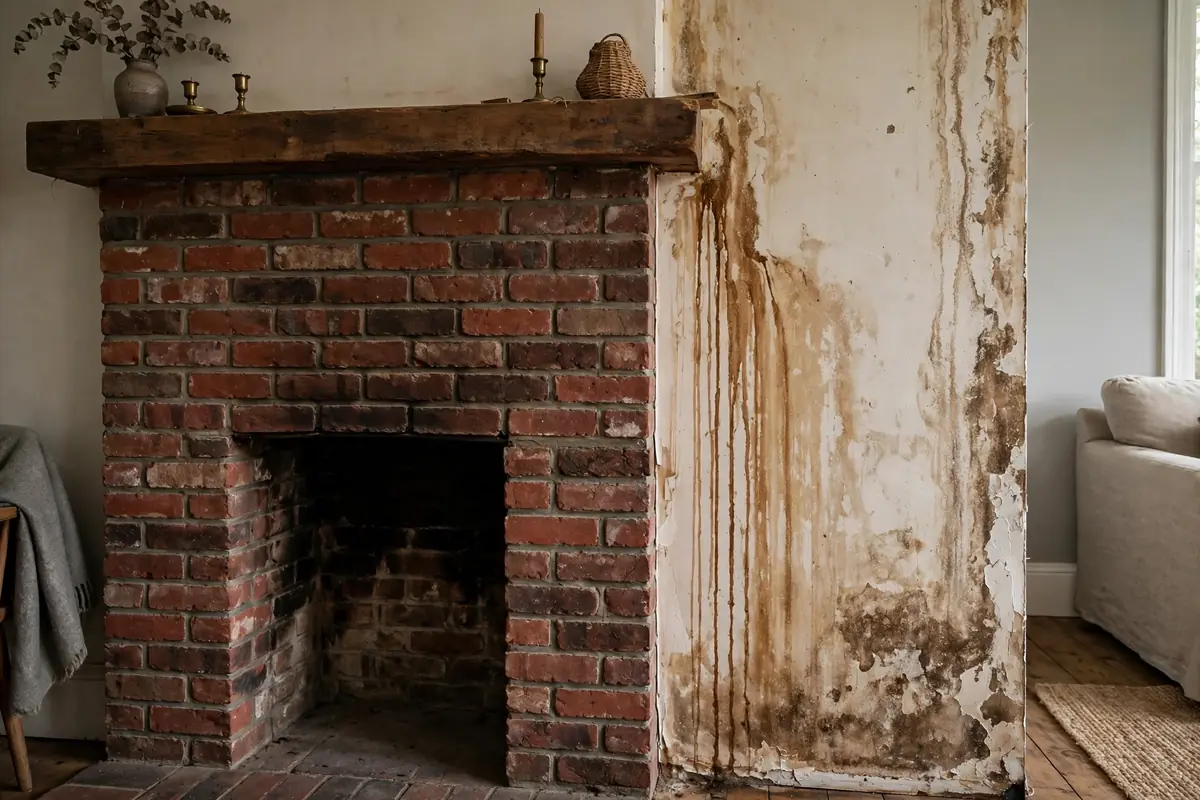
There is a brown stain on the wall beside the fireplace, and a musty smell you cannot quite place. The stain is not where the water got in — it is where the water ended up. Water damage around fireplaces rarely sits where it started, because water travels: along rafters, behind drywall, under flooring, until it finds somewhere to show itself. By the time you see it, it has been travelling a while.
Key Takeaways
- The stain is the end of the water’s journey, not the start — water travels along framing and behind drywall before it shows.
- Damage appears in order: surround first, then mantel, then drywall, then flooring, then the smell.
- Efflorescence — white powdery deposits on brick — means water has been moving through the masonry for a while.
- Water in the firebox means top entry: cap, crown, or liner.
- A stain far from the chimney usually means the water travelled, not that the chimney is innocent.
- Do not paint over the stain or seal it — the entry point is still open, and the water will come back.
In This Post
- The Short Answer
- The Surround: The First Thing You See
- The Mantel: Wood That Moves
- The Drywall: Soft Spots and Bubbling Paint
- The Flooring: Cupping, Swelling, and Stains
- The Smell and the Mould: What You Cannot See
- The Symptom-to-Entry Decoder
- Efflorescence: The White Powder That Tells the Truth
- Does Water Damage the Flue Liner?
- What to Do Next
- Frequently Asked Questions
The Short Answer
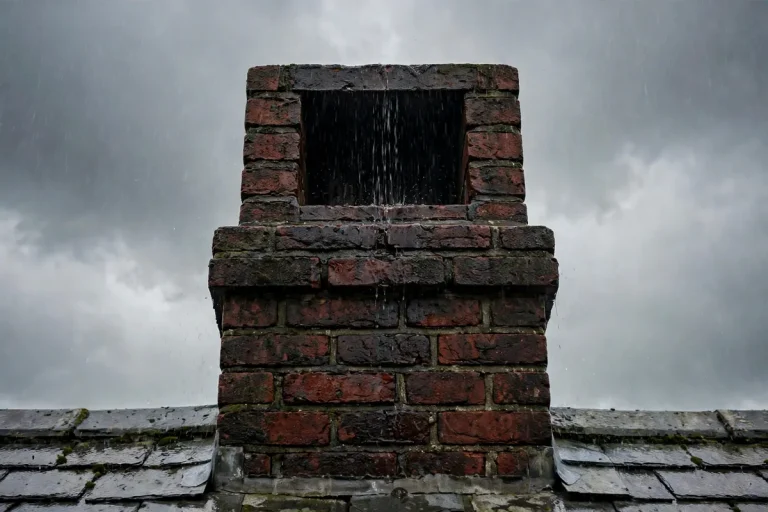
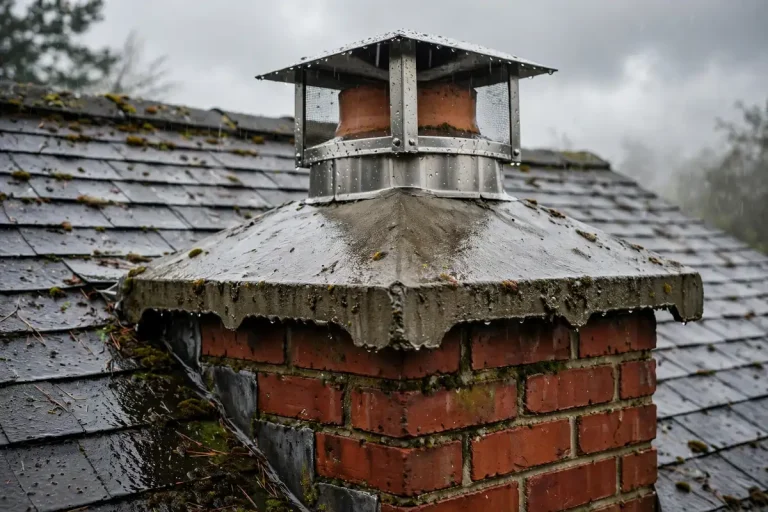
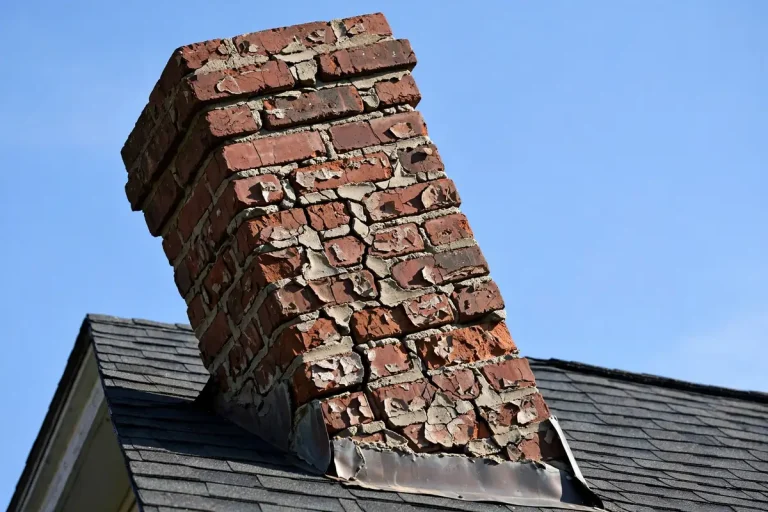
It starts at the top of the chimney and shows up at the bottom of the room. Rain gets in through the cap, the crown, the flashing, or the masonry, travels down along the flue and the framing, and appears as a stain on the surround, the drywall, or the floor — sometimes several feet from where it entered and a full storey below it.
If you have not yet worked out whether the water is coming from the chimney at all, start with our guide on roof leak or chimney leak — the four tests that tell you which one it is. Our guide on why chimneys leak walks through the five entry points in order. This post is about what the water does once it is inside — the damage, in the order you will find it.
The Surround: The First Thing You See
The surround is the face of the fireplace — tile, stone, or brick around the firebox opening — and it is usually where water damage shows first, because it is the lowest masonry the water reaches before it meets the room.
What to look for: staining or discolouration on the tile or stone, grout that has darkened in patches, brick that looks wet long after rain, and white powdery deposits on the surface. The surround may feel damp to the touch even in dry weather, because masonry soaks up water and releases it slowly — a stain that keeps growing a day after the weather clears often means the brickwork absorbed water during the storm and is still letting it through.
Water inside the firebox itself is the clearest version of this: pooling water, a damp smell from the fireplace, or rust on the damper means the water came down the flue from the top, not through the wall. That is a cap, crown, or liner problem, and it is a chimney problem, not a roofing one.
The Mantel: Wood That Moves
The mantel is usually wood, and wood moves when it gets wet. A mantel that has been absorbing moisture will warp, pull away from the wall at the joints, or show gaps opening where it meets the surround. Paint or finish lifts and peels, and the wood swells and then shrinks as it dries, which opens the joints a little wider each time.
Mantel damage is easy to misread as age — old houses have mantels with gaps. The difference is the pattern: gaps that track the wet seasons, paint lifting on the underside or the ends rather than the face, and a mantel that feels damp after rain. A mantel that is only ever dry on the face and damp underneath is telling you water is getting in behind it, not in front of it.
Do not sand and repaint a damp mantel. Paint over wet wood traps the moisture inside, and the finish will lift again with the next storm — the water is still getting in, and the mantel is still the place it shows.
The Drywall: Soft Spots and Bubbling Paint
Drywall is where the damage stops being cosmetic. Water travelling behind the wall soaks the back of the drywall first, so by the time the front shows a stain, the inside has been wet for a while. Soft spots that give under a fingertip, paint that bubbles or peels, plaster that has gone powdery, and trim that has warped away from the wall are all drywall-stage damage.
This is also where the travel matters most: water damage around fireplaces is hard to trace because the stain sits where the water landed, not where it got in. Water runs along the top of the drywall, along joists, and behind the wall before it drops — so a stain on the ceiling a few feet from the chimney can still be chimney water, and a stain right beside the chimney can still be roof water. The stain is evidence that water got in; it is not evidence of where.
If the drywall feels soft, do not poke through it to look inside — a soft spot means the board has lost its strength, and opening it up is a job for the inspection, not for a fingertip. Note where the soft spots are and when they darken — during rain, or a day after — and that timing goes to the inspector with the stain.
The Flooring: Cupping, Swelling, and Stains
Flooring is the last hard surface the water reaches, and it shows the damage in the material’s own language. Hardwood cups — the edges of the boards rise above the centres — and the cupping follows the path the water took, usually in a line running away from the chimney breast. Laminate swells at the joints and lifts. Carpet stays damp underfoot and dries last. Hearth tiles loosen as the adhesive underneath gives up.
Floor damage is also the most expensive to leave, because it spreads: a cupped floor that is left wet will keep cupping, and the subfloor underneath rots silently while the surface still looks mostly fine. If the floor near the fireplace is damp after rain, the water has been travelling through the wall and under the floor for longer than the stain suggests. The fix is not a new floor — it is the entry point, found and closed, and then the floor.
The Smell and the Mould: What You Cannot See
The smell comes last, and it is the sign homeowners notice most once they know what it is: a musty, earthy smell near the fireplace that does not go away with airing the room, strongest after rain or in humid weather. It means something organic has been wet for a while — wood, drywall paper, or insulation inside the wall cavity.
Mould grows in enclosed cavities where water has been sitting, and you will usually smell it before you see it. Do not disturb a mouldy area to look at it — if you suspect mould, consult a professional and let them decide how to handle it. The smell is not a diagnosis and this post is not one; it is a signal that water has been inside the wall longer than the stain shows, and that the entry point needs finding.
The Symptom-to-Entry Decoder
Read the symptom first, then the entry point. The table works backwards from what you can see to where the water most likely got in — and the inspection confirms it.
| What you see | What it usually means |
|---|---|
| Water in the firebox, or rust on the damper | Top entry — a missing or damaged cap, a cracked chimney crown, or water down the flue |
| Ceiling stain near the chimney, no firebox water | Flashing or roofline — the chimney flashing where the chimney meets the roof |
| Efflorescence or rust on firebox doors | Long-standing moisture moving through the masonry |
| Stain far from the chimney | Water travelled along framing — trace it back to the chimney |
| Damp that keeps spreading a day after rain | Masonry absorbed water — crown, mortar joints, or flashing |
| Wet in dry weather, or worst on cold mornings | Not rain — condensation or plumbing, a different fix entirely |
Two rows deserve a second look. The first is water in the firebox: it is almost never a roof leak, and it is the one symptom that points straight at the top of the chimney. The second is the stain far from the chimney: it is the row homeowners get wrong most often, because the instinct is to fix the roof above the stain. The water travelled — and the travel is the whole story of this post.
Efflorescence: The White Powder That Tells the Truth
Efflorescence is the white, powdery deposit that appears on brick when water moves through masonry: the water dissolves salts inside the brick and mortar, carries them to the surface, and leaves them behind as a white crust when it evaporates. It is the most honest sign on this page, because it only appears where water has actually travelled through the masonry — it cannot be faked by a spill or a one-off damp patch.
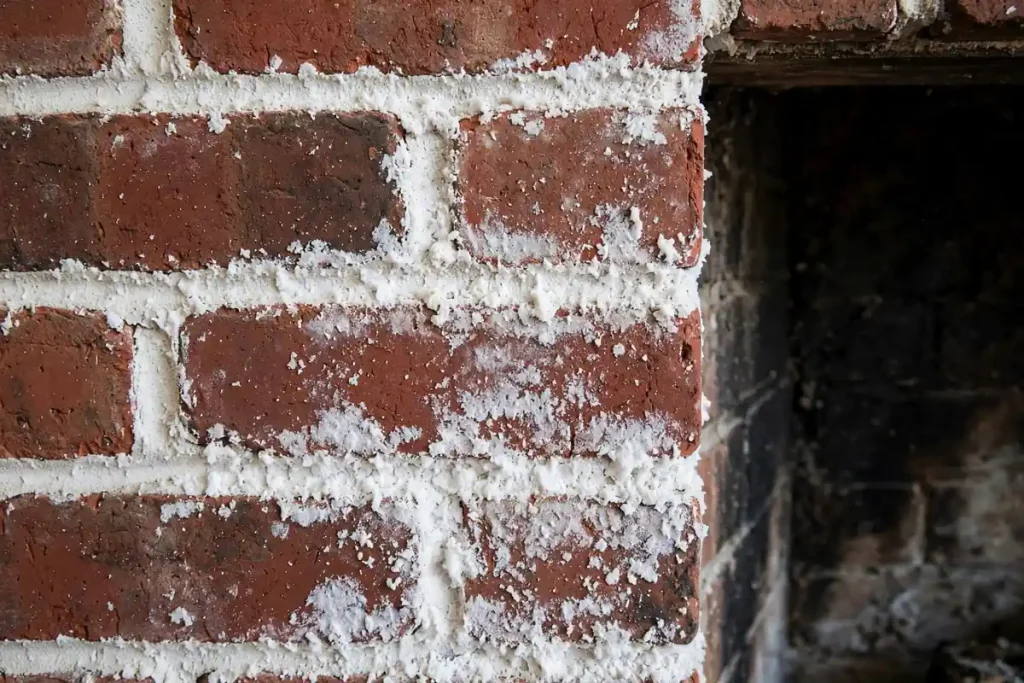
Is efflorescence proof of an active leak? Not by itself. The deposits can be old — left behind by water that got in years ago and has since been fixed. What it proves is that water has moved through that masonry, and for how long it has been happening. Fresh, powdery deposits that return after brushing mean water is still moving through. Old, hard crust that does not come back means the entry point may already be closed. Either way, it is worth showing to the inspector, because it marks the path the water took.
Does Water Damage the Flue Liner?
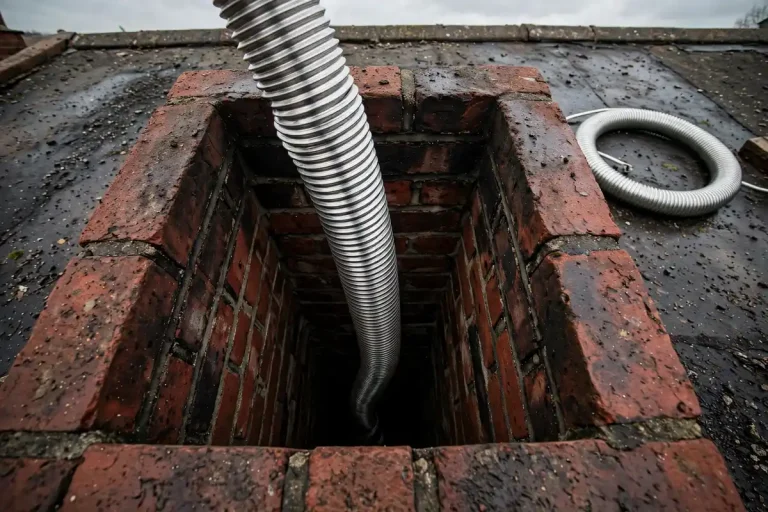
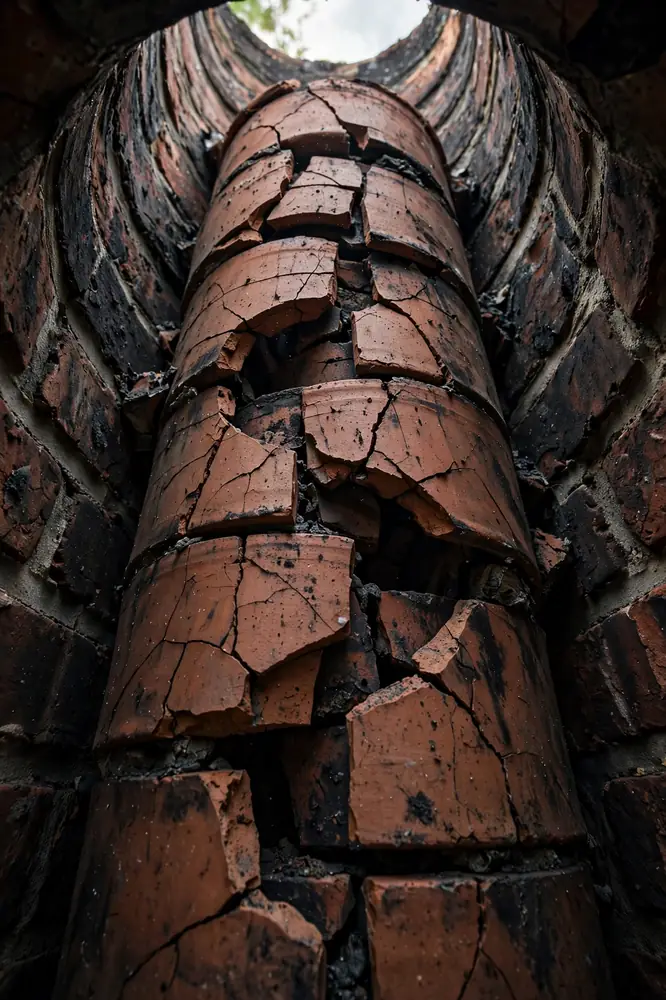
Yes — and this is the part of the post that stops being about the room and starts being about safety. Water that reaches the flue liner accelerates liner failure: it soaks clay tiles, erodes mortar joints, and corrodes metal liners from the outside in, while creosote and acidic condensation attack from the inside. A liner that is wet on both sides fails faster than a liner that is only ever attacked from within.
Water in the firebox is the warning: it means water is already inside the flue, in contact with the liner. That is a safety matter, not just a repair question, and it is why a damp fireplace is not a “watch it and see” job. The liner is the barrier between the fire and the house, and water is one of the things that wears it out.
What to Do Next
Once the entry point is known, the fix follows it — and our chimney leak repair guide walks through the fixes in order: crown, cap, flashing, masonry, liner. But the order matters: find the entry point first, then fix it. A repair booked on a guess costs the same as the right repair and fixes nothing.
If the tests in this post and our guide on how to find the source of a chimney leak have not settled it, that is what the inspection is for. An inspection looks at the chimney and the roofline around it together, traces the water back to its entry, and says plainly what needs fixing — and whether it needs a repair, a replacement, or nothing at all.
The Bottom Line
That is water damage around fireplaces in one sentence: the stain is the last thing the water does, not the first — and finding the entry point matters more than fixing the stain. Walk the room in order, read the symptom against the decoder, and do not paint over what the water is trying to tell you.
If you have worked through this post and still cannot tell where the water is getting in, that is what the inspection is for. Call Portland Chimney Care at +1 (503) 433-7104. We serve Portland, OR, and we can tell you plainly whether it is the flashing, the crown, the cap, or something else — and whether it needs a repair, a replacement, or nothing at all.
Frequently Asked Questions
Sources
- Airflow Solutions
- Paul Davis
- Tidewater Chimney
- Champion Brick Repair